hybrid work urbanite event 10

Data, however, never lies.

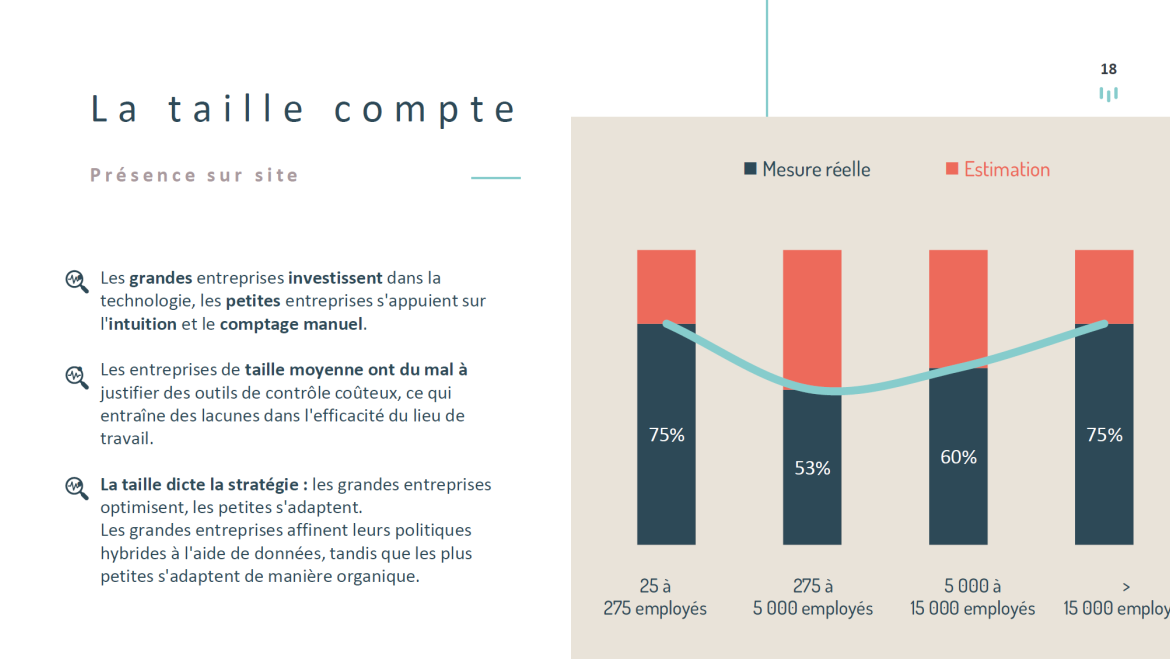
Executives overestimate office usage by +12%.


Make decisions based on reliable data rather than impressions, with the third edition of our Hybrid Work Report.


COMPANIES THINK THEY KNOW. THE DATA SHOWS SOMETHING ELSE.

According to the AREMIS Hybrid Work Report 2025, the majority of organizations continue to manage their offices by sight:


Result: poorly utilized spaces, excessive costs, and poorly coordinated teams.

    • They overestimate office occupancy by +12%, leading to poorly timed real estate decisions.

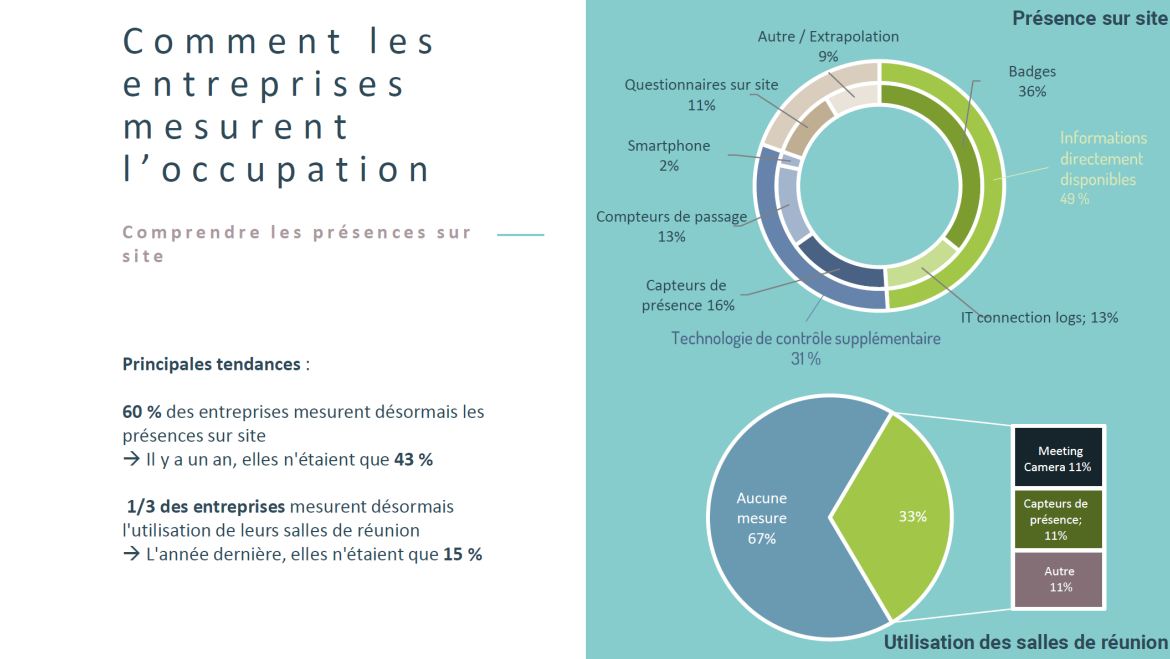
    • 40% of companies still do not measure any actual occupancy data.

    • Meeting rooms are measured by only 1 in 3 companies.

    • Fluctuations in visitor numbers create uncontrollable peaks on Tuesdays and Thursdays

orange
EVIDENCE: WHAT LEADERS SAY

DIRECT BENEFITS FOR YOUR ORGANIZATION

1. Reduce real estate costs

Up to –45% depending on the scenarios analyzed

2. Offering a better employee experience

46% of companies now measure user experience (vs. 32% in 2024)

3. Streamlining collaboration

Thanks to Team Agreements and understanding peak workloads

4. Reduce your carbon footprint

–14.4% reduction in annual CO₂ emissions with 2.5 days of remote work per week 

hybrid work urbanite event 09
 
Companies that master their hybrid work data have a strategic advantage.

HOW DATA IS TRANSFORMING YOUR WORKPLACE

1. Understanding Office Attendance

Companies today use:

👉 Objective: to know who comes, when, and why.


2. Measuring the actual use of spaces


Only a third actually analyze what happens in meeting rooms

👉 Objective: reduce friction, optimize floor space, adjust collaborative areas.


3. Structuring Flexibility (New Standard 2025)


👉 Objective: balance between team autonomy and business needs.


4. Quantifying Business Impact (ROI)

Real-World Example of the Report:

👉 Objective: To make the right decisions, quickly and factually.

  •  
    • Badges (36%)

    • Attendance Sensors (16%)

    • IT Logs (13%)

    • Meeting Cameras (11%)

    • 87% of companies have a policy of 2–3 days of remote work

    • Team Agreements are growing rapidly.

    • 100% flexibility is giving way to structured flexibility.

    • For an organization of 500 employees:
    • –45% annual cost reduction, or €1,675,000, thanks to data-driven workspace optimization
hybrid work urbanite event 06
cas_concret_hybrid_02.png CAS RÉELS (EXTRAITS DU RAPPORT)
cas_concret_hybrid_01.png CAS RÉELS (EXTRAITS DU RAPPORT)
DOWNLOAD THE 2026 REPORT
investment
EVIDENCE: WHAT LEADERS SAY

These testimonials show that the most advanced organizations are now basing their strategies on concrete data, not feelings.

DPG Media

“The result is that we are finally able to make decisions.”

Kris De Bisschop, DPG.


Questions & Answers


Hybrid work & workplace data — FAQ

Find here the answers to the most frequently asked questions about occupancy measurement, usage analysis and our data-driven approach.

NEED TO KNOW MORE?

Do I need sensors to measure office occupancy?
No, sensors are only one of the available options. We can already deliver meaningful insights using data you often already have: badge access histories, IT login logs, meeting room bookings, on-site observations, etc. Sensors can be added if you wish to go even further.
Can usage be analysed if our hybrid work policy is not yet clearly defined?
Yes. For many organisations, data collection and analysis are precisely the starting point for clarifying or adjusting a hybrid work policy. Our approach focuses on objectively assessing the current situation (presence, occupancy, team behaviours) to help you define fairer and more widely accepted rules.
What type of data do I need to provide for the preliminary analysis?
We adapt our analysis to your context and your level of data maturity. In practical terms, you may share: floor plans and areas, HR data (headcount, organisation, sites), badge access histories, login logs, booking statistics or any other available source. We guide you to identify what is genuinely useful.
How long does it take to obtain the first results?
The preliminary analysis offered on this page is delivered within 48 working hours after receiving the basic information. For a full study including scenarios, recommendations and change support, timelines vary depending on the size of your organisation and the volume of data, but the first actionable insights usually emerge within a few weeks.
Does the analysis also cover meeting rooms and collaborative spaces?
Yes — and this is actually a key element of our approach. Meeting rooms, project spaces and collaborative areas often concentrate most of the frustrations and overload. We analyse their utilisation rates, occupancy patterns and team needs to identify concrete adjustments to put in place.
What type of benefits or savings can I expect?
Benefits may be real estate-related (space reduction or improved allocation), operational (less friction, better planning) and human (employee experience, attractiveness, engagement). The level of impact depends on your starting point, but in many cases, data-driven workspace optimisation delivers significant savings while improving the quality of the working environment.
Is it too early for us if our organisation is still in the middle of its hybrid transition?
No — on the contrary: it is often the best time to objectively assess the situation. The transition to hybrid work happens through iterations. Having clear data on presence, occupancy and team expectations helps avoid policy “back-and-forth” and enables you to build a stable and sustainable framework more quickly.
What types of organisations do we support with this approach?
We support organisations of various sizes and sectors: financial services, public sector, industry, life sciences, TMT, FMCG, real estate, etc. Our methodology is designed to adapt equally well to large international organisations and mid-sized companies actively evolving their hybrid work model.
 
EVIDENCE: WHAT LEADERS SAY
Contact us